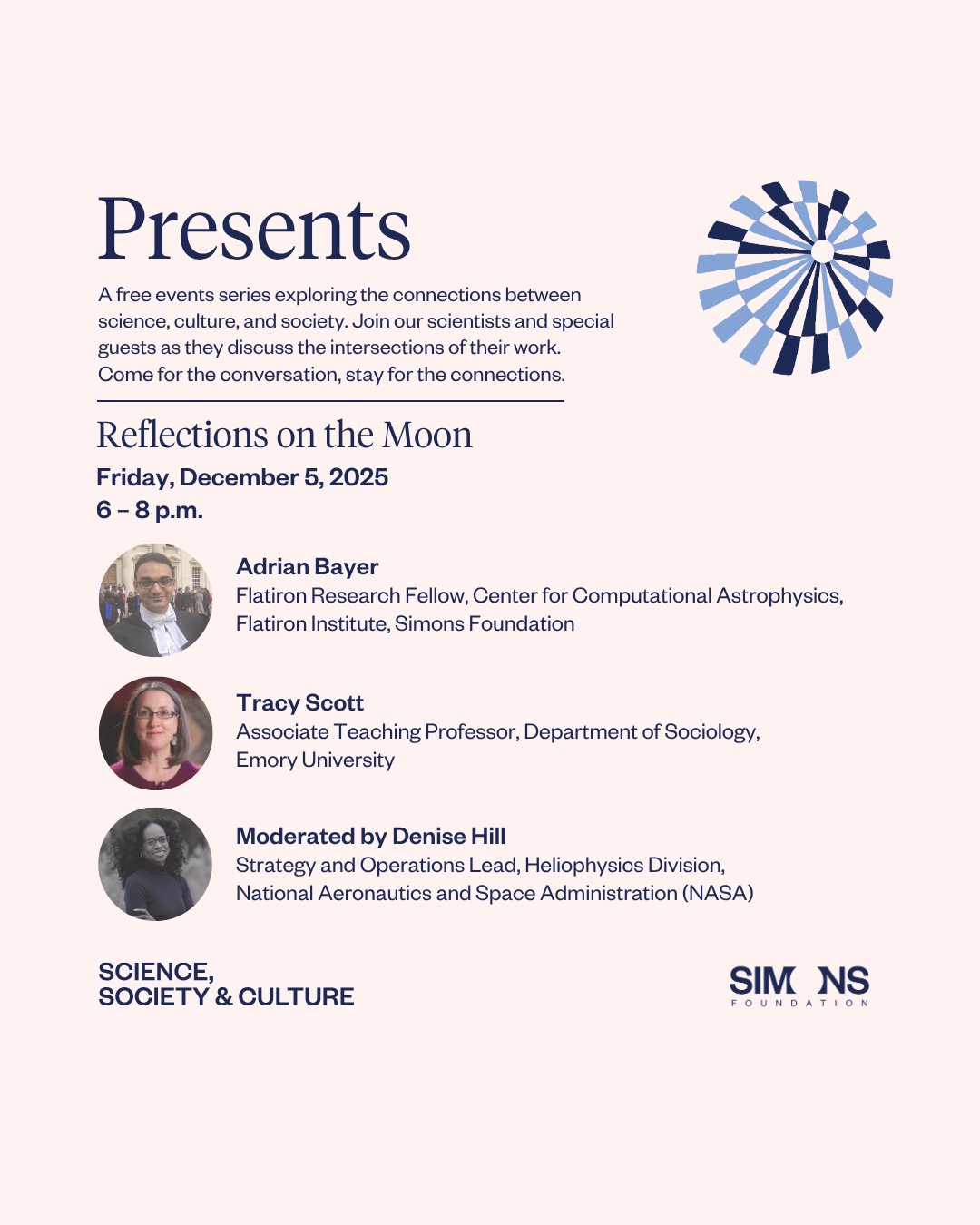


Simons Foundation Presents: Reflections on the Moon
12/5
6:00 pm – 8:00 pm
For as long as humans have looked up, the moon has shaped our imagination and our history. It pulls our tides, inspired the space race and still looms large in science and culture. Yet from Earth, we’ve only ever seen one side of it. Our first glimpse of the far side came in 1959, and only 24 humans have ever seen it in person, leaving it steeped in myth and mystery.
Cosmologist Adrian Bayer studies the universe across its history from its oldest light to the vast structures of galaxies and dark matter that shape its evolution. Relative to his work, the far side of the moon — which is shielded from radio waves from Earth’s constant noise — could be the perfect site for a next-generation radio telescope with the potential to transform our understanding of the cosmos.
Sociologist Tracy Scott, daughter of Apollo astronaut Commander David R. Scott, brings a unique lens as both researcher and “astronaut kid.” Her work explores the connections between society and NASA’s moon missions and highlights how evidence can deepen critical thinking, spark reflection and guide more informed choices in science and everyday life.
Join us under the final full moon of 2025 as Bayer and Scott sit down with NASA’s Denise Hill for a conversation about what the moon continues to teach us, from its role in science and discovery to the cultural and personal stories it carries.
Registration opens 3 weeks before the event and closes at 2PM day-of.
ABOUT THE SPEAKERS
Bayer is primarily a cosmologist who specializes in simulating and analyzing the large-scale structure of the universe and the cosmic microwave background. His work aims to optimally uncover the secrets of our universe, such as the fundamental nature of dark matter and dark energy and the mass of neutrinos. He also develops statistical and machine learning tools for use throughout astrophysics and beyond. Bayer studied physics at Imperial College London, earned a master’s in applied mathematics at the University of Cambridge, completed a Ph.D. in physics at the University of California, Berkeley, and now holds a joint research position at the Flatiron Institute and Princeton University.
Scott received an A.B. in economics from Stanford University and a Ph.D. in sociology from Princeton University. From 2014 to 2020, she was director of Emory University’s Quality Enhancement Plan, “The Nature of Evidence: How Do We Know?” Scott’s current research project (“Moonshot Astronauts and Their Families: Exploring Image vs Reality in the Early Space Era”) brings together her history as an early-era “astronaut kid” (daughter of David R. Scott of Gemini 8, Apollo 9 and Apollo 15) with her professional expertise as a sociologist.
Hill is the strategy and operations lead for NASA’s Heliophysics Division (HPD). She is instrumental in helping manage HPD’s multi-million-dollar flight portfolio dedicated to studying the sun and its profound impact on Earth, the solar system and the space environment. Before this role, Hill was HPD’s communications, outreach, and media relations lead. Her prior experience includes leading communications for the Department of Health and Human Services’ COVID-19 vaccine hesitancy campaign and the Health Equity Task Force, as well as serving as a senior speechwriter and policy editor at the Department of Transportation, where she led communications for the Research and Technology Office. Hill began her career as an educator and curriculum developer, where she specialized and conducted extensive research in the areas of child psychology, brain research and gifted and talented education.
Flatiron & NoMad Businesses: Have an event to add? Submit it here